Monkey Sausage Font
If you’ve ever stared at a blank design canvas wondering how to inject instant charm, personality, or lighthearted energy into your project—Monkey Sausage might be the playful spark you didn’t know you needed. It’s not just another display font. It’s a carefully crafted typographic tool designed for moments where warmth, wit, and visual rhythm matter more than rigid formality.
A Font That Feels Like Playtime—Without Sacrificing Craft
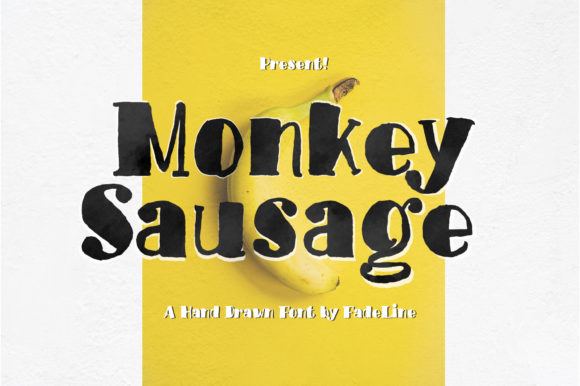
Monkey Sausage is a hand-drawn-inspired display typeface with bold, rounded letterforms, uneven baselines, and subtle bounce in its curves. Letters tilt just enough to suggest motion—like a cartoon character mid-jump—and spacing leans into generous, breathable proportions. It’s not chaotic; it’s intentionally expressive. Each glyph balances irregularity with consistency, so headlines stay legible even at smaller sizes (down to ~36px on screen), and large-scale applications pop without overwhelming.
What sets Monkey Sausage apart isn’t just its quirk—it’s how thoughtfully that quirk is engineered. The weight distribution supports strong contrast between thick downstrokes and delicate terminals. Uppercase letters command attention; lowercase forms invite approachability. And unlike many “fun” fonts that flatten into novelty, Monkey Sausage holds up across mediums: print, web, SVG, and even embroidery digitizing workflows—thanks to clean vector outlines and well-hinted OpenType features.
Where This Font Earns Its Keep
Think of Monkey Sausage as your go-to for any context where tone matters as much as message. Not every brand needs seriousness. Some need delight. Some need reassurance. Some need to stand out in a sea of minimalist sans-serifs—and do it with sincerity, not irony.
Crafting & DIY Projects
Hobbyists and small-batch makers use Monkey Sausage on handmade soap labels, greeting cards, and seasonal market banners. Its friendly texture pairs beautifully with kraft paper, watercolor backdrops, or linen textures. One ceramicist told us she uses it exclusively for her “Mug of the Month” series—it signals warmth before the customer even reads the description.
Educational Materials for All Ages
Teachers and curriculum designers report strong engagement when Monkey Sausage appears in classroom posters, reading logs, or digital slide decks for younger learners. Its open counters and generous x-height improve readability for emerging readers, while its personality helps reduce cognitive load during repetitive tasks like spelling practice or behavior charts.
Digital & Social Content
On Instagram or Pinterest, where scroll speed is measured in milliseconds, Monkey Sausage stops thumbs—not because it’s loud, but because it feels human. Bloggers use it for section headers in craft tutorials or recipe roundups. Marketers apply it selectively in email subject lines or limited-time offer banners where friendliness builds trust faster than urgency alone.
Branding With Personality (Not Gimmicks)
Small businesses—especially those rooted in wellness, creative services, or family-focused offerings—leverage Monkey Sausage for secondary branding elements: taglines, packaging accents, or website callouts. A Brooklyn-based kids’ yoga studio uses it only for their “Breathe In, Giggle Out” motto. It reinforces values without hijacking their primary logo or compromising professionalism.
Real Talk: When (and When Not) to Use It
Monkey Sausage thrives in short-form, high-impact roles: headlines, logos, buttons, quotes, event names, product names, and signage. It’s less effective for body copy, legal disclaimers, data tables, or interfaces requiring dense information scanning. If your audience includes people with dyslexia or low-vision users, pair it with a highly legible companion font (like Inter or Lato) for supporting text—and always test contrast ratios against WCAG 2.1 AA standards.
Also worth noting: licensing. Monkey Sausage is available under standard desktop, web, and app licenses—but if you’re embedding it into a SaaS dashboard or white-labeled tool, verify extended usage terms upfront. Many creators assume “one license fits all,” then hit roadblocks during deployment.
Pairing It Thoughtfully
Its playful nature doesn’t mean it can’t play well with others. In fact, Monkey Sausage gains sophistication when anchored by neutral, structured fonts. Try it with:
- Inter or Roboto for clean, accessible UI text
- Merriweather or Source Serif Pro for long-form blog content
- Montserrat or DM Sans for balanced marketing layouts
Avoid pairing it with other display fonts—especially those with competing personalities (e.g., distressed, ultra-thin, or script styles). Simplicity in supporting type gives Monkey Sausage room to breathe and shine.
Practical Tips for Getting Started
Start small. Drop Monkey Sausage into one high-visibility element first—a hero headline, an email CTA button, or a workshop title—and watch how it shifts perception. Track engagement metrics if possible: time-on-page, click-through rate, or social shares often increase when tone aligns authentically with audience expectations.
When exporting for web, use variable font files if available—they reduce load times and give you fine-grained control over weight and width. For print, export PDF/X-4 with embedded fonts and outline critical text where needed (e.g., die-cut templates).
And don’t overlook kerning. While Monkey Sausage ships with solid default spacing, manual tweaks to pairs like “AV”, “To”, or “Wa” make a visible difference in premium-feeling layouts. Most design tools let you adjust this non-destructively—even in Canva, using the “letter spacing” slider judiciously helps.
Final Thought: Personality Is a Design Decision
Choosing Monkey Sausage isn’t about chasing trends. It’s a deliberate choice to communicate joy, accessibility, or humanity—without saying a word. In a world saturated with algorithm-optimized sameness, fonts like Monkey Sausage remind us that thoughtful design still starts with empathy: for the reader, the maker, and the moment.
So next time you’re choosing a typeface—not just for what it says, but for how it makes people feel—ask yourself: does this serve the message, or distract from it? With Monkey Sausage, the answer, more often than not, is a cheerful, confident yes.